Many of us move through our days without ever fully breathing.
Stress has a way of quietly changing the body. The shoulders tighten. The jaw clenches. Thoughts begin moving faster than we can process them. And somewhere in the middle of all of it, the breath becomes shallow and constricted.
When we’re anxious, overwhelmed, rushing from task to task, or emotionally overloaded, we often begin breathing only into the upper chest without even realizing it. This shallow style of breathing can intensify the mental fog, tension, and anxiety we already feel. The body interprets fast, restricted breathing as a signal that we are unsafe or under pressure.
Over time, many people become disconnected from the natural rhythm of their breath entirely.
In Reiki practice, breath is foundational because it helps guide us back into presence, awareness, and connection with ourselves.
One of the most grounding breathing techniques used within Eastern healing traditions is called Hara breathing.
The hara refers to the energetic center of the body located a few inches below the navel. In Japanese traditions, this area is often associated with grounding, stability, vitality, and inner balance. Hara breathing focuses on deep abdominal breathing, encouraging awareness of both the body and the flow of energy within it.
Unlike many forms of breathing where the abdomen expands only during inhalation, Hara breathing emphasizes softness and expansion throughout the entire breath cycle, both inhaling and exhaling. There is a sense of openness and continuity rather than contraction.
The practice is somewhat similar to Pranayama in yoga, though Hara breathing places particular emphasis on the lower abdomen as the center of awareness and energetic grounding.
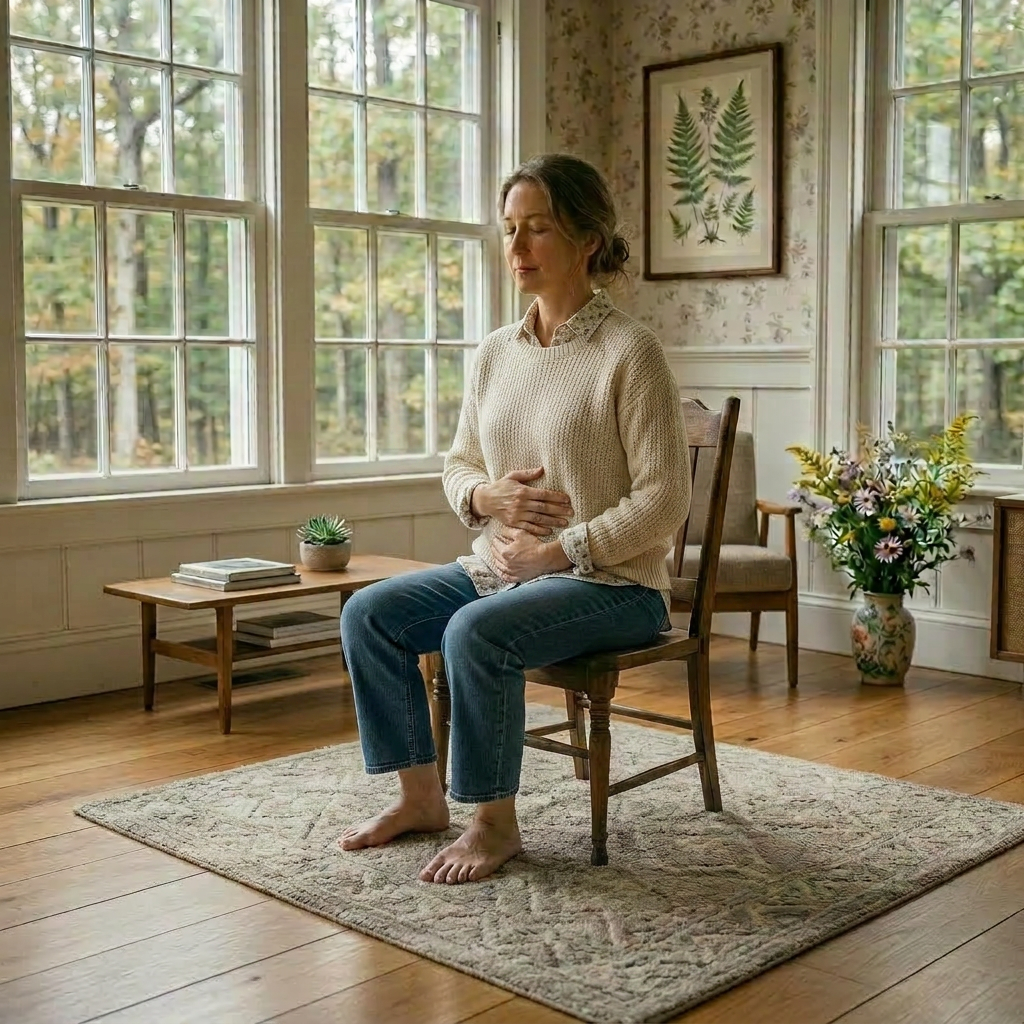
Traditionally, the hands are placed gently below the navel while breathing slowly and intentionally into the abdomen. But the breath itself is only part of the practice.
The mind is involved as well.
As you inhale, you may imagine energy flowing in through the crown of the head and moving throughout the body. Gently circulating, nourishing, and awakening awareness. Then, as you exhale, you can imagine that energy softly radiating outward through the body and into the surrounding room. With each slow exhale, the room becomes more filled with calm, grounded presence.
This imagery is not about forcing anything to happen. It simply helps guide attention inward and encourages a sense of spaciousness and connection.
Hara breathing has been respected and practiced within Eastern healing traditions for generations because of its ability to cultivate steadiness in both the mind and body.
And modern understanding of the nervous system helps explain why practices like this can feel so regulating.
When we slow the breath, the body’s miraculous systems begin recognizing safety.
The nervous system responds to long, intentional breathing patterns by activating the parasympathetic nervous system, the part of the body responsible for rest, restoration, digestion, and relaxation. The heart rate may soften. Muscles begin releasing tension. Thoughts may slow down. The body shifts away from survival mode and toward regulation.
This is one reason intentional breathing can feel so powerful during stressful seasons of life.
The breath becomes a bridge between the mind and body.
It reconnects us to the present moment.
And in Reiki, presence is where healing begins.
A Simple Hara Breathing Practice
You can try this practice for just a few minutes each day:
- Sit comfortably in a quiet space.
- Place both hands gently below your navel.
- Relax your shoulders and soften your jaw.
- Inhale slowly into the lower abdomen, allowing the belly to expand naturally.
- Exhale slowly while keeping softness and openness in the abdomen.
- As you inhale, imagine energy flowing through the crown of the head and throughout the body.
- As you exhale, imagine that energy gently radiating outward into the room around you.
- Continue for 3–5 minutes without forcing the breath.
- Simply notice what shifts within you.
You may notice warmth, calmness, emotional release, tingling sensations, or simply a quieter mind. You may also notice nothing dramatic at all, and that is perfectly okay. The practice is not about achieving a specific outcome. It is about creating space to reconnect with yourself.
In Reiki sessions, breath often becomes the doorway into deeper awareness. Before the body can soften, before the mind can quiet, before subtle energetic shifts can be noticed, there is usually a single conscious breath.
A return to center.
A return to self.
Experience the Flow
If you’re feeling overwhelmed, disconnected, or simply in need of space to slow down, Reiki and breathwork can offer gentle support for the nervous system and mind-body connection.
I offer virtual Reiki sessions designed to help you relax, reconnect, and create moments of calm from the comfort of your own space.
Leave a Reply